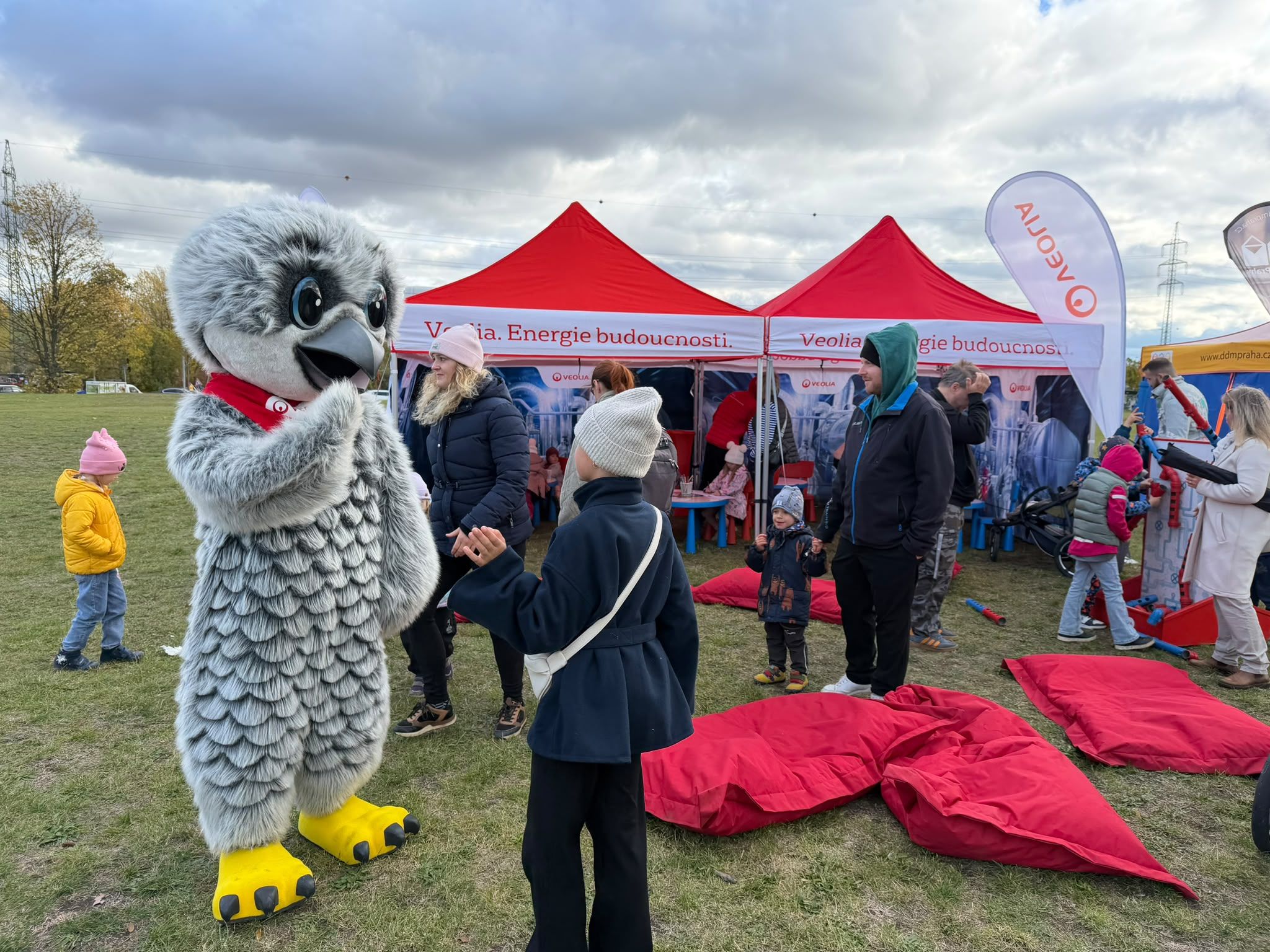
A corporate event has a clear guest list and starts at a set time. A public event in the city works differently. People come and go all day, bring their children, stop for five minutes or for an hour. Nobody invites them by name and nobody has to persuade them to stay. Either the zone catches their interest, or they walk past.
For Veolia we built an experience zone in a city park that was designed with this in mind from the start.
The brief
The goal was for the Veolia brand to meet people naturally. Not through a leaflet, but through an experience. The zone had to do three things:
- be visible from afar, so that people on the other side of the park would notice it,
- entertain different age groups, from small children to parents and grandparents,
- give the client’s team room to talk to visitors instead of dealing with operations.
How we built the zone
A visible brand
Tents, flags and furniture in Veolia’s visual identity. In a park full of greenery and other stalls, it has to be clear at first glance who is here and that there is something to experience. We work with height (flags above the tents), with colour, and with keeping the zone open towards the path people walk along.
Activities you can join straight away
At a public event nobody has the patience to listen to long rules. We therefore build the stations so that people can join in within seconds. Children try a game while their parents have a moment to talk with the client’s team. We lay out the activities so they lead into one another and people stay in the zone longer.
Back-of-house out of sight
Behind every good-looking zone there is a place where materials are restocked, where the equipment sits, where the team can sit down for a moment and where things that should not be seen are kept. We plan this back-of-house as carefully as what visitors see.
What we watch out for at public events
Outdoor events for the public have their own risks. That is why we deal with these in advance:
- Weather. Tents and facilities have to withstand sun and showers, and the programme needs a plan B. In the sun people need shade and water; in the rain, a covered space for activities.
- Visitor flow. We place stations so that people do not crowd in one spot and the zone does not get in the way of other activity in the park.
- Safety. Activities for children have to be safe even without constant parental supervision. We check tent anchoring, cables and anything that could tip over.
- All-day operation. Materials, refreshments and staff have to last through the afternoon rush, when the park is busiest.
- Permits and site rules. Public space has its own rules for occupancy, noise and cleaning. We settle them well ahead so nothing surprises us on the day.
Why an experience works better than a leaflet
People take a leaflet, fold it and throw it away at home. An experience they remember. When a child plays a game at the stand and the parent chats with someone from the company, the brand becomes linked in their minds with a pleasant moment in the park. That is value classic advertising cannot deliver.
But event marketing only works when the operations are under control. If the client’s team spends the day hunting for an extension cord or figuring out where to put boxes, there is no time left to talk to people.
The result
Veolia’s team spent the day talking to people, not solving logistics. That is the main thing in event marketing. People remember the brand because of what they experienced, and someone else takes care of the operations.
Who the format suits
An experience zone at a public event makes sense for companies that want to:
- show what they do to people they would not normally come into contact with,
- strengthen their relationship with the local community in the city where they operate,
- give employees the role of brand ambassadors outside the office.
We build roadshows, promotional events and brand events in a similar way. The scale differs, the principle stays the same: an experience for visitors, peace of mind for the client.